
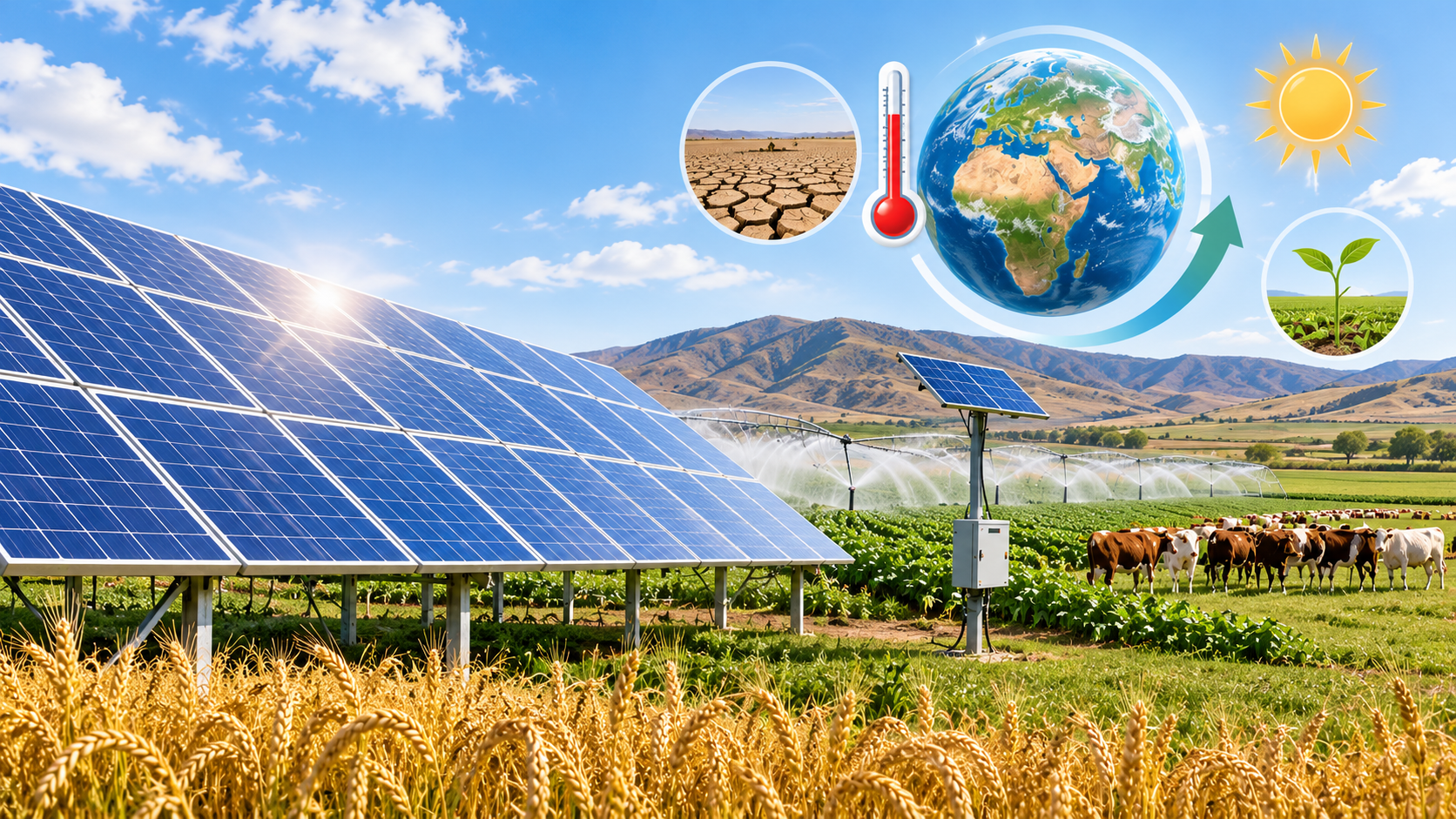
Renewable energy is gaining ground in Kazakhstan’s agricultural sector. One of the most notable developments is the growing use of solar panels on farms in remote areas. Experts say the trend is being driven by a combination of climate change and gaps in the country’s energy infrastructure. But are farmers prepared for these changing conditions? And how can renewable energy help them adapt to a changing climate?
Solar Power Offers a Solution to Electricity Shortages
The Dauren farm in the Abai Region is located nearly 60 kilometres from the district centre. Its pastures cover approximately 1,550 hectares, and the farm raises 802 head of pedigree cattle. According to its owner, Nurtugan Manap, climate change has had an increasingly noticeable impact on agriculture in recent years. Water shortages are becoming more severe, while the amount of available pastureland continues to shrink.
Unreliable electricity supplies pose another challenge. Located far from the district centre, the farm struggles to secure a sufficient and stable supply of power, even as its electricity needs continue to grow.
To address the problem, Manap has begun turning to renewable energy. The farm has installed a solar-powered water pumping system. Powered by solar panels, the pump switches on automatically at sunrise and draws water from deep underground. This gives livestock grazing on the pastures access to clean, mineral-rich water throughout the day. Manap says cattle that drink it are healthier, in better condition and produce better-tasting meat.
The Dauren farm is far from the only one facing these challenges. Hundreds of farms across Kazakhstan are grappling with similar pressures linked to climate change and energy shortages. As temperatures rise and water resources become increasingly scarce, renewable energy is emerging as an important tool for helping rural communities adapt.
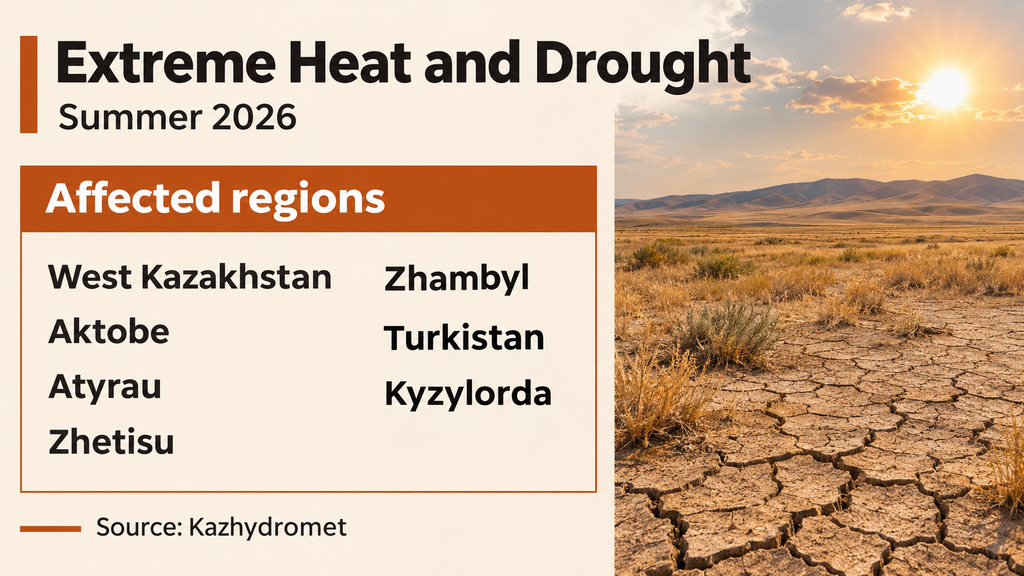
According to Kazhydromet, severe heat and drought affected the West Kazakhstan, Aktobe, Atyrau, Zhetysu, Zhambyl, Turkistan and Kyzylorda regions in the summer of 2026. Temur Yunusov, Doctor of Biological Sciences and scientific adviser to the Central Asia Climate Foundation (CACF), says rising global temperatures are contributing to sharp daily and seasonal temperature fluctuations, as well as more frequent droughts and plant diseases.
How Many Farms Does Kazakhstan Have?
According to the Ministry of Energy, all populated localities in Kazakhstan have access to electricity. However, there is no single, precise official figure for remote farms and wintering grounds that remain disconnected from the central power grid.
Data from the Bureau of National Statistics show that the number of agricultural entities rose by 42% in 2025, from 204,000 to 290,000. The number of agricultural enterprises more than doubled, increasing from 9,500 to 21,000. Meanwhile, the number of peasant and farming households and individual entrepreneurs grew from 194,000 to 269,000.
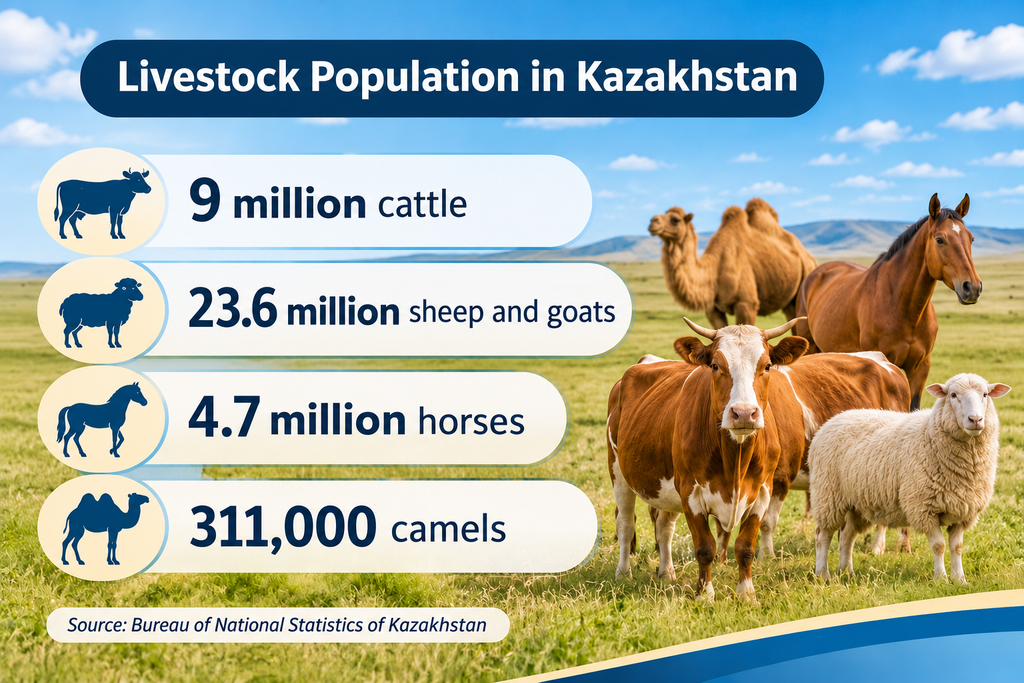
Kazakhstan’s livestock population includes:
9 million head of cattle;
23.6 million sheep and goats;
4.7 million horses;
311,000 camels.
The country also has an extensive area of cropland, covering 23.2 million hectares.
In recent years, the agricultural sector has increasingly felt the effects of unpredictable weather. In 2025, favourable conditions and the use of modern agricultural technologies helped Kazakhstan harvest a record 27.1 million tonnes of grain. The 2026 growing season, however, has presented the sector with a new set of challenges.
Adapting to these conditions requires a reliable electricity supply, which is essential for operating irrigation systems and introducing modern agricultural technologies. Yet access to power remains a serious concern for pastures and wintering grounds located far from the central grid.
Solar Panels Are Now Made in Kazakhstan
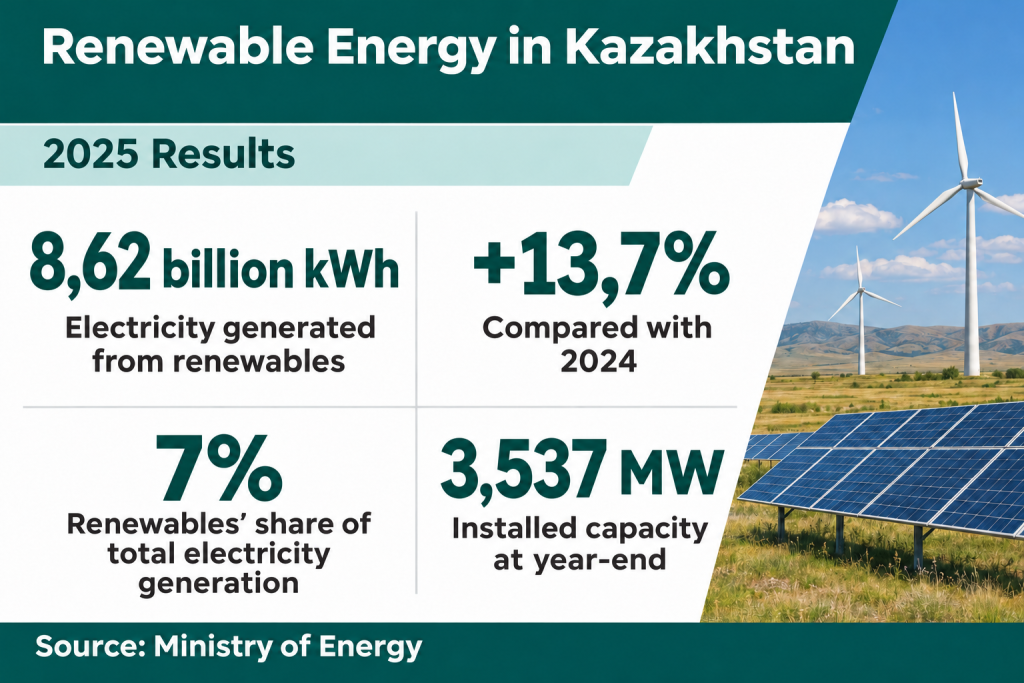
At the end of 2025, renewable energy sources generated 8.62 billion kWh of electricity, 13.7% more than in 2024. According to the Ministry of Energy, renewables accounted for 7% of the country’s total electricity generation. By the end of the year, Kazakhstan’s installed renewable energy capacity had reached 3,537 MW.
Wind power accounted for the largest share, with an installed capacity of 1,909 MW. Solar power plants followed with 1,313 MW, while small hydropower plants accounted for approximately 314 MW. Bioenergy facilities had a capacity of 1.77 MW.
Wind farms also led in actual electricity generation, producing 5.38 billion kWh. Solar power plants generated 2.04 billion kWh, small hydropower plants produced 1.2 billion kWh, and bioenergy facilities generated approximately 2.8 million kWh.
A further 10 renewable energy facilities, with a combined capacity of 245 MW, were scheduled to come online in 2026. Most have already been commissioned.
However, the electricity generated by these facilities primarily supplies farms and agricultural enterprises connected to the central grid. Businesses located farther away, or those expanding their operations without access to sufficient power, continue to face shortages.
Many are therefore turning to solar energy. Interest is growing not only among small-scale farmers but also among large agricultural enterprises. One example is Abzal and K, a company based in Kyzylorda, which generates part of its electricity needs using solar panels.
In recent years, the company has focused on modernising its production facilities, introducing advanced technologies and improving energy efficiency. Solar power has become an important part of this effort.
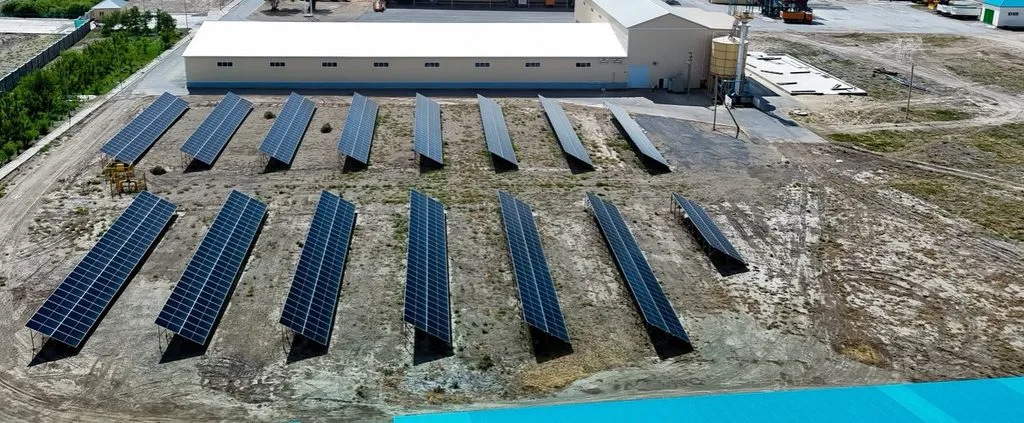
Solar power plants have been installed at the company’s production facilities and office buildings. The main production site has a capacity of 500 kW, while the system installed at the office building has a capacity of approximately 80 kW — substantial investments for an agricultural enterprise.
Sagidulla Syzdykov, Commercial Director of Abzal and K, outlined the main benefits of installing solar panels:
“First and foremost, they have helped us reduce our electricity bills. Our company operates several production facilities equipped with numerous electric motors, fans, conveyors, drying units and processing machines. All this equipment consumes large amounts of electricity.
“Secondly, installing solar power plants has encouraged us to pay even closer attention to energy efficiency. We now regularly monitor how much electricity each facility consumes, how much energy the solar panels generate and what factors affect their performance.
“Finally, there are clear environmental benefits. Solar power is a clean, renewable source of energy. As we expand production, we also want to reduce our environmental footprint.”
According to the article’s figures, 70–75% of solar panels used in Kazakhstan are deployed in the livestock sector. Hundreds of autonomous solar-powered pumping systems have been installed under the state investment subsidy programme to provide water to remote pastures. These systems are mainly used to supply livestock in the Aktobe, Almaty, Kyzylorda, Mangystau and East Kazakhstan regions.
Net Consumer Status: An Incentive or an Obstacle?
More than 650 agricultural enterprises and farms across Kazakhstan have introduced digital and green technologies, many of which include solar panels. Farmers say that while they had to order panels from China just a few years ago, domestic production is now beginning to develop as well.
One example is a pilot industrial workshop at Satbayev University. Working in cooperation with TechnoGroupService, the university produces solar modules with an annual capacity of up to 150 MW. The modules are designed to deliver high efficiency and stable output while withstanding Kazakhstan’s varied climatic conditions.
Built for long-term use, the panels are already being installed at several industrial facilities. Their combination of quality and competitive pricing makes them suitable for businesses as well as private households.
Yeldos Abakanov, Chair of the Public Council under Kazakhstan’s Ministry of Ecology and Natural Resources and a mentor at the Taldau expert community, believes that installing solar panels on farms and residential buildings can bring both environmental and economic benefits.
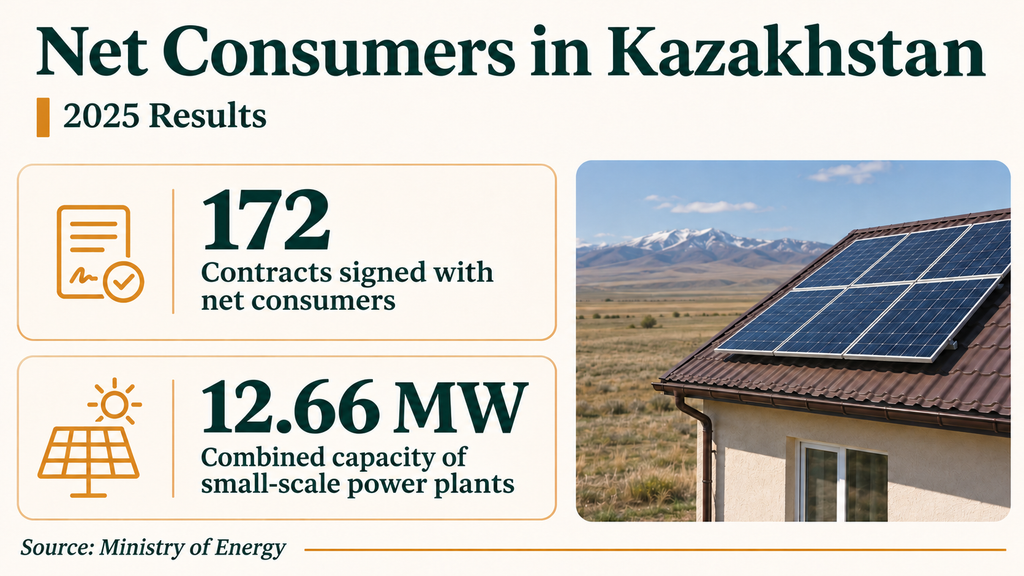
“This sector has yet to gain widespread adoption in Kazakhstan. At the end of 2025, there were 172 agreements with net consumers, and the combined capacity of their small power plants stood at 12.66 MW. The market is growing, but it is still at an early stage nationwide.
“I believe economic policy should give this area greater attention. The potential can be illustrated with a simple calculation: installing 5 kW solar systems on 100,000 rooftops would provide a combined capacity of 500 MW. This is only an illustrative estimate. Achieving it would depend on the suitability of rooftops, the capacity of electricity networks and access to financing,” Abakanov says.
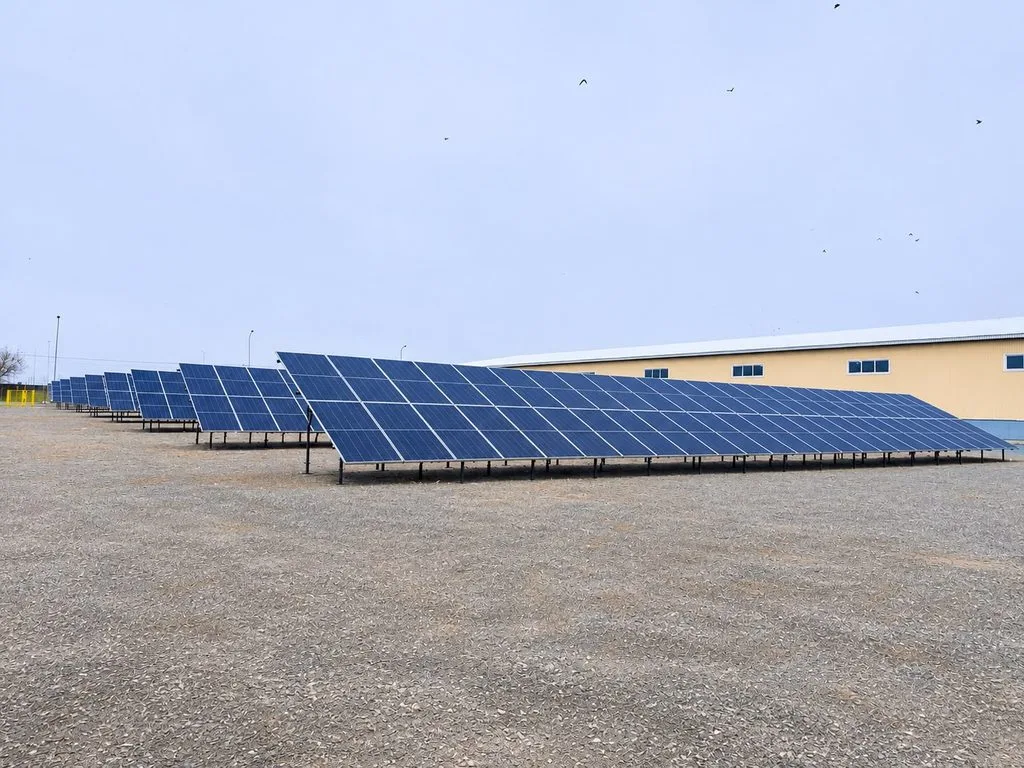
Kazakhstan has also introduced a framework for net consumers. Under this system, small businesses and rural residents can install solar panels to meet their own electricity needs and sell surplus power to the local grid at an average tariff.
Following legislative amendments, individual entrepreneurs and livestock farmers with small solar installations of up to 200 kW have become more active in the net consumer market. The system offers an additional source of income for businesses operating near crop-growing areas and livestock facilities.
Nevertheless, the practice remains far from widespread. According to the Ministry of Energy, Kazakhstan had 172 net consumer agreements at the end of 2025, with a combined small-scale generation capacity of just 12.66 MW. Although the market is expanding, it remains at an early stage of development.
Lessons from International Experience
Many farms around the world already generate their own electricity using solar panels, with governments supporting the transition through various incentive programmes.
In Australia, for example, the number of rooftop solar systems reached four million in 2024. At the time, one in every three households had solar panels. Growth was supported by a small-scale renewable energy programme that helped reduce upfront installation costs by around 30%.
India has introduced a similar initiative, the PM Surya Ghar programme. By August 2026, more than five million households had benefited from rooftop solar installations under the scheme. Its support package combines subsidies, concessional loans and a unified digital application system.
Abakanov believes Kazakhstan needs similarly consistent support, particularly in the form of investment incentives for farmers.
“Building owners do not need to be energy specialists or investors themselves to install solar panels on their rooftops. A specialised company can secure financing, install the equipment and provide maintenance. The building owner then purchases the electricity generated at an agreed price that is favourable to them,” he says.
According to Abakanov, Kazakhstan already has a practical example of this business model. A 65 kW solar power plant was installed on the roof of the Abai Garment Factory through Green Platform. Under the arrangement, the factory purchases solar-generated electricity at a price 15% below the existing tariff.
Over nine months, the plant generated 64,850 kWh of electricity. Taking monthly net settlements into account, it covered approximately 90% of the enterprise’s electricity consumption.
The project illustrates how a new market model can work: an investor provides the financing, a service company maintains the equipment, and the business benefits from lower electricity costs.
Almas Abildaev, Director of the Kazakhstan Energy Aspects Research Centre and an energy expert, says that moving away from conventional energy sources on a large scale and switching to solar power would be difficult for many farmers. Such a transition requires substantial investment and upgrades to existing infrastructure.
“When we look at energy developments around the world, we can see two different approaches: the European and the American. Europeans support a decisive transition to green energy, whereas the United States sees it as part of a broader energy transformation. The US recognises the need for decarbonisation but is in no hurry to introduce immediate legislative measures to regulate the process.
“Our approach is broadly similar. Rather than giving green energy one-sided priority, we continue to rely on conventional energy sources as well,” Abildaev says.
Teginbolat Samuratov, an energy efficiency and sustainable development expert who currently works with the Mass Save programme in the United States, points to the scale of investment required to modernise Kazakhstan’s energy infrastructure.
According to Samuratov, 167.8 billion tenge was invested in energy efficiency between 2019 and 2024. Investments of 41.7 billion tenge in electricity generation resulted in savings of 10.2 billion tenge. Meanwhile, 126.2 billion tenge was invested in electricity transmission and distribution networks, generating savings of just 14.4 billion tenge.
“At first glance, the return on investment in the second area may seem very low. However, there is an objective reason for this. Modernising electricity and heating networks is a highly capital-intensive process that takes time.
“For example, replacing an old burner in a boiler house can deliver results relatively quickly. Reconstructing heat distribution networks, 60% of which are worn out, can take several years and require billions of tenge.
“That is why the effectiveness of such investments should not be judged solely by the amount of money saved in the short term. Other factors must also be taken into account, including accident prevention, lower energy losses, improved system reliability and a longer service life for infrastructure,” Samuratov says.
According to the expert, access to initial capital remains one of the main obstacles. Some enterprises simply do not have the hundreds of millions or billions of tenge needed to begin modernisation. Others struggle to secure financing on favourable terms. When borrowing costs are high, even a technically efficient project can become financially unattractive.
“The government should not simply tell businesses to ‘save energy and use solar panels’. We need practical instruments such as concessional financing, guarantees, subsidies and energy service contracts. These would allow enterprises to cover their costs over time through the savings generated by improved energy efficiency, rather than having to finance the entire investment upfront,” Samuratov says.
Solar Panels: Costs, Payback and Returns
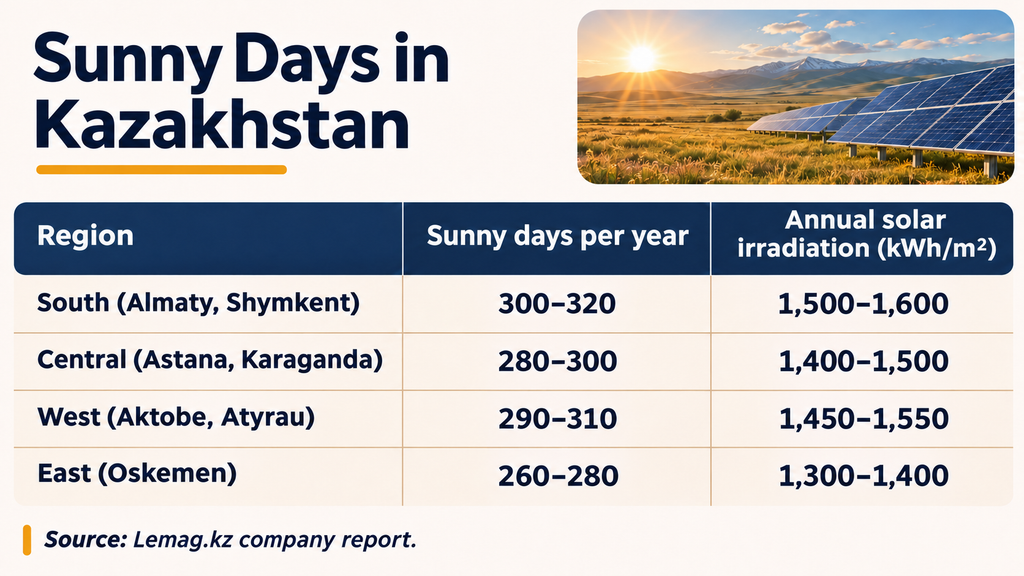
According to calculations by Lemag.kz, Kazakhstan’s climate is well suited to solar power generation. The country receives substantial amounts of sunshine throughout the year, although conditions vary by region:
South (Almaty, Shymkent): 300–320 sunny days a year and 1,500–1,600 kWh/m² annually.
Central region (Astana, Karaganda): 280–300 sunny days and 1,400–1,500 kWh/m².
West (Aktobe, Atyrau): 290–310 sunny days and 1,450–1,550 kWh/m².
East (Oskemen): 260–280 sunny days and 1,300–1,400 kWh/m².
Installing a 10 kW solar power system costs an average of 4.26–5.87 million tenge. Taking rising electricity tariffs into account, the estimated payback period is between seven and 12 years.
Lemag.kz also forecasts that by 2028, between 5,000 and 10,000 households could install solar panels each year, bringing the combined capacity of privately owned solar systems to 500 MW. Meanwhile, panel prices are falling by 5–10% annually. By 2028, a 5 kW system could cost between 1.8 million and 2.2 million tenge.
However, solar power output depends heavily on weather and seasonal conditions. Farmers confirm that the performance of a solar power plant is influenced by the time of year, weather, panel orientation and the enterprise’s electricity consumption.
For example, Abzal and K’s 500 kW solar power plant generated more than 100,000 kWh of electricity in July — a particularly strong result. Solar panels can cover a significant share of a farm’s electricity needs, especially during the summer months, when daylight hours are longer and sunshine is more abundant. The same level of output, however, is unlikely during winter.
Syzdykov says the company initially planned to expand its solar generation capacity to one megawatt. However, existing legislative restrictions have put those plans on hold.
“Initially, we planned to increase the total capacity of our solar power plants to one megawatt. We intended to continue investing in this area and reduce the cost of electricity used in production. However, current legislative restrictions, particularly the 200 kW limit for net consumers, are preventing us from moving forward.
“For now, we have been forced to put the expansion project on hold. We are not prepared to invest additional funds unless the existing restrictions are revised.
“In my view, if the government is serious about developing renewable energy, it should first create favourable conditions for businesses that are investing their own money in such projects. We are not asking the state for financial assistance. We simply need clear and effective rules that allow us to invest our own funds and generate clean energy,” Syzdykov says.
Kazakhstan also plans to present a dedicated platform for financing green and climate-related projects at the COP31 summit. The initiative is intended to attract international investment for projects involving renewable energy development, industrial modernisation and more efficient water use.
“According to this year’s official statement, Kazakhstan will present a dedicated platform to international partners at COP to attract green and climate finance. Its main purpose is to showcase promising projects in our country and secure funding for them. Climate funds established under the Paris Agreement could be used to implement major investment projects in Kazakhstan,” Abakanov says.
Meanwhile, the Department of Groundwater at the Ministry of Water Resources and Irrigation says farmers who use groundwater can currently receive subsidies covering up to 85% of their electricity costs. The authorities are also considering reducing taxes and the signing bonus associated with groundwater use.
Yersin Shamshadin
Central Asia Climate Campaign 2026 is implemented by the MediaNet International Centre for Journalism and n-ost with support from the Federal Ministry for Economic Cooperation and Development (BMZ) of the Federal Republic of Germany as part of the project “Communicating Climate in Central Asia”.
